Every Thursday morning, I’d sit at the café with my lukewarm cappuccino and my half-hearted attempt at journaling.
It had become part of my ritual ever since I moved to this sleepy town on the edge of Oregon’s coast.
Not much really happened here, but that was kind of the point. After six years in Seattle, I needed somewhere the noise couldn’t find me.
The market opened late, the air smelled like salt and bread, and the people mostly kept to themselves. It was all I wanted.
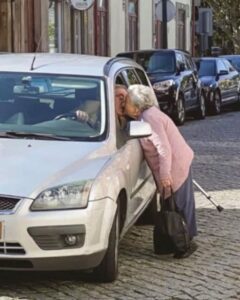
Every Thursday at nine, a silver Ford Crown Victoria would pull up right across the street. The driver was an older man, always in a tweed jacket even in the summer, white hair combed back like he had somewhere important to be. But he never got out. Instead, he’d wait—hands folded on the wheel, eyes scanning the sidewalk.
And then she’d come.
She moved slowly, cane in hand, but carried herself with a quiet dignity that seemed untouched by time. Always in a pink cardigan, always with a black tote bag. Her lips painted the softest rose. She’d lean into the open window of the Ford, kiss him gently on the cheek—or sometimes the lips—and whisper something that would make his mouth curl into the kind of smile you only see in people who know something you don’t. Then she’d straighten, adjust her bag, and hobble into the market like she hadn’t just made my whole day.
I didn’t know them. Not their names, not their story. I never waved, never even made eye contact. Just sat across the street pretending to write while I waited for that kiss. It made everything feel less heavy. Like maybe love didn’t expire.
Then one Thursday, the car didn’t come.
It was strange, how quickly I noticed. No silver glint. No hazarded blink. I stared across the street, coffee cooling between my hands, trying to rationalize it. Maybe they were running late. Maybe he forgot. Maybe the car broke down.
But then I saw her.
She was moving slower than usual, her cane tapping unevenly on the brick sidewalk. She paused where the Ford always parked, as if surprised by the emptiness. Her lips pressed together. Her eyes scanned the road like she’d misplaced something. Or someone.
She stood there for a long time.
I didn’t think. I just got up and crossed the street.
“Ma’am?” I said softly, careful not to startle her. “Are you okay? Do you need help?”
She turned her head and looked at me—really looked at me—with eyes that were more water than blue. “He passed on Monday,” she said, like it was the only sentence she’d managed to rehearse.
I didn’t know what to say. But I offered to walk her to the market. Just for that day.
She accepted, her hand light on my forearm, like if she held too tight the memory would slip out of reach.
Her name was Lillian. She was eighty-six, widowed once before, and had met Frank—the Frank—at a library event fifteen years ago. They never married. “Didn’t feel the need,” she said, her voice creased with amusement. “But every Thursday, he drove me to the market and waited like a gentleman.”
I asked her what she used to whisper through the window.
“Oh, I just told him what I was going to buy,” she said, smiling softly. “And he’d always guess something ridiculous like caviar or fireworks.”
We shopped together that day. She showed me how to pick good plums and told me the butcher never remembered her name but always called her “darlin’.” When we said goodbye, I figured that was it. A sweet, quiet encounter, something to write about in my journal.
But the next Thursday, I parked my car in that same spot. Hazards on.
I don’t know what made me do it. Maybe it was the empty curb. Or maybe it was the look in her eyes when she said his name. Maybe I just didn’t want the story to end like that.
She stepped onto the sidewalk, pink cardigan fluttering in the breeze, and when she saw me, she laughed.
“You even parked crooked,” she said. “Just like him.”
We fell into step easily. It wasn’t the same as before—I wasn’t Frank, and she wasn’t waiting to kiss anyone—but it became ours in a way that didn’t feel like stealing.
We made it a ritual.
She started telling me about her younger years. How she once danced on a rooftop in Boston, barefoot and half-drunk. How she almost moved to Paris but got distracted by a man in uniform. How she lost people, found others, and came to believe that love wasn’t a constant—it was a rhythm. You just had to know when to catch the beat.
I started opening up, too. Told her how I left a job I hated and a relationship that dulled me down until I couldn’t remember what color I liked anymore. How I felt like I was floating, waiting to feel grounded again.
“You’re grounded now,” she said one Thursday, holding a bouquet of daisies like they were wild treasure. “You just didn’t notice when it happened.”
And she was right.
I started looking forward to Thursdays. Not just for the company, but for the steadiness of it. For how the smallest gestures—crooked parking, shared coffee, the way she said my name—could reframe your entire week.
She started calling me “kid,” though I was thirty-three.
“I have a grandson older than you,” she’d joke. “But he doesn’t know how to pick good plums.”
One day, I asked her why she never took a different ride. A cab, a neighbor. “Why wait at the curb?”
She shrugged. “I think we all wait for something that feels familiar. Even when it’s gone.”
Eventually, she let me drive her not just to the market, but to her book club. To her doctor’s appointments. To her favorite diner with the jukebox that still worked if you hit it twice. I wasn’t replacing Frank—I never could—but I was showing up. And she was letting me.
One day, she handed me a folded paper. A letter.
“If I forget, or if I go first, give this to him,” she said.
“To who?”
“To the man who parks for you.”
I laughed, nervously. “I don’t think there’s going to be—”
“You don’t get to decide when someone parks for you,” she said, tapping my hand with her cane. “But when they do, notice it. And leave the hazards on.”
It’s been a year now. Every Thursday, I still park by the market. Hazards blinking.
Some weeks, Lillian isn’t up for the walk, but I go anyway. I still grab her groceries. I still visit. I’ve met her grandson—Grant—who works for a software company in Minneapolis and blushes when she calls him out for forgetting her birthday. We’ve gone out a few times, actually.
He told me once, “I haven’t seen her smile like this in a long time. I think you brought something back.”
But I didn’t. I just waited at the curb.
And now, every Thursday, she waits for me.
If this story touched you, if it made you smile or remember someone you love, please share it. Maybe someone out there needs a reminder that love doesn’t vanish. Sometimes, it just changes cars.