Imagine a backpack that isn’t just a backpack. By day, it carries your essentials.
By night, it becomes a safe, warm place to sleep.
That’s exactly what a small team of innovators in Germany is making a reality—a portable solution for people experiencing homelessness that combines practicality, safety, and dignity.
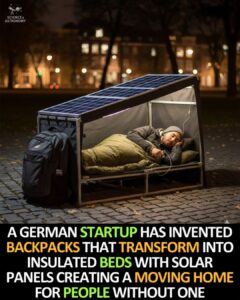
This is not just another sleeping bag. It’s a carefully designed, high-tech emergency bed packed into a compact backpack. For people forced to sleep on the streets, it can mean the difference between a freezing, unsafe night and a warm, secure one.
The backpack is simple in concept but powerful in function. It unfolds into an insulated bed, providing protection against cold and dampness. A built-in solar panel charges small devices or powers a light, giving users access to a bit of comfort and connectivity even in the darkest nights. A tiny LED lamp provides safety and privacy, and a phone port allows users to call for help, check shelter availability, or stay in touch with friends and family.
While it’s not a full home and doesn’t solve homelessness by itself, it’s an essential lifeline. It gives people a moment of rest and dignity—something that’s often taken for granted. On a cold night, having a warm space and a working light is more than convenience; it’s survival. And for someone navigating the daily challenges of life without a permanent home, even a charged phone can be a lifeline, helping them connect with services, job opportunities, or support networks.
This innovation reflects a broader trend: designers around the world are creating smarter, portable emergency gear to help people in need. Some focus on clothing that doubles as a sleeping space, while others develop compact pods or tents that provide shelter when traditional facilities are full. Students and young engineers have even built solar-powered tents that offer warmth and light, ensuring that people don’t have to choose between basic necessities.
The German backpack-bed sits right in the middle of this movement. It’s straightforward, human-focused, and designed with empathy. Imagine handing one to someone who has been turned away from shelters all day. You show them how it folds out, zip up the hood, and click on the lamp. The relief is immediate. Shoulders relax. The small gesture carries immense meaning.
Cities, charities, and makers collaborating could significantly improve the safety and well-being of people living on the streets. And while long-term solutions like housing-first programs and comprehensive social services remain critical, small innovations like this backpack make a tangible difference in the meantime.
The backpack is also designed with sustainability in mind. By using solar power to charge devices and lights, it reduces reliance on external electricity sources. Its durable materials are meant to withstand harsh weather conditions, ensuring longevity and practical usability. This is an example of social entrepreneurship at its best—leveraging technology and design to solve urgent human problems.
Beyond functionality, the backpack embodies dignity. Homelessness can be isolating and dehumanizing, and many people struggle just to feel safe. Providing a personal, secure space—even for a single night—restores a sense of agency and respect. It shows that someone, somewhere, cares enough to think about their comfort, safety, and basic human needs.
Innovation like this also sparks awareness. When communities see that practical, small-scale solutions can improve lives, it encourages further action. From designers to governments to volunteers, everyone can play a role in ensuring that people without homes have access to basic necessities and, eventually, long-term housing solutions.
In a world where homelessness is an ongoing crisis, the German backpack-bed is a reminder that technology, design, and empathy can converge to create real, human-centered solutions. It won’t end homelessness overnight—but for someone on a cold, dark street, it’s a beacon of hope.
Sources:
1. Designboom – Ulmer Nest: Solar-Powered Shelter for Homeless People
2. Vogue – Sheltersuits Can Save Lives: The Non-Profit’s Upcycled Backpack
3. WBUR Here & Now – Teenage Engineers Build Solar-Powered Tent to Help Homeless