In a groundbreaking medical achievement, doctors have successfully restored 83 percent of a man’s skull using an innovative combination of 3D printing technology and titanium implants.
This extraordinary procedure, described as one of the most extensive cranial reconstructions ever attempted, marks a pivotal moment in modern medicine and offers renewed hope to patients suffering from devastating head injuries that were once thought impossible to repair.
The patient, whose identity has not been disclosed for privacy reasons, suffered catastrophic skull damage after a traumatic accident.
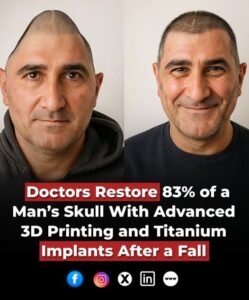
In such cases, traditional surgical methods often fall short, as they are unable to replicate the complex shape and protective function of the skull with the necessary precision. Conventional approaches rely heavily on manually crafted plates or grafts, which frequently leave gaps or irregularities. These limitations put patients at risk of long-term complications and do little to restore appearance. Faced with these challenges, the surgical team turned to cutting-edge 3D printing, a technology increasingly transforming fields ranging from engineering to healthcare.
The process began with highly detailed imaging scans of the patient’s cranial structure. These scans were then converted into a precise digital model, allowing doctors to design a replacement implant tailored exactly to the missing sections of the skull. With the help of advanced 3D printing technology, a titanium framework was created layer by layer, ensuring both strength and an almost perfect anatomical match. This level of customization was unprecedented, offering surgeons an implant that fit as seamlessly as a missing puzzle piece.
Once the framework was printed, surgeons performed the delicate operation to secure it into place. The titanium implant restored more than four-fifths of the skull, not only protecting the brain but also recreating the natural contour of the head. Physicians noted that the reconstruction offered critical medical protection while also addressing psychological and emotional needs. For patients with visible cranial injuries, recovery is not just about survival—it is also about reclaiming a sense of identity and confidence.
Post-surgery updates have been remarkably encouraging. Doctors report that the patient is recovering well, regaining mobility, strength, and self-assurance. The transformation has been both physical and emotional, as the reconstruction significantly improves quality of life. For many who suffer similar injuries, the impact extends beyond health to include social reintegration and mental wellbeing, making procedures like this truly life-changing.
Medical experts emphasize that the choice of titanium played a major role in the surgery’s success. Titanium has long been valued in medical science for its durability, resistance to corrosion, and compatibility with the human body. Its ability to integrate safely with living tissue makes it an ideal material for long-term implants. When combined with the unmatched precision of 3D printing, titanium opens entirely new possibilities in reconstructive surgery. Conditions ranging from severe trauma and congenital deformities to cancer-related bone loss may now be treated with personalized solutions that were unimaginable just a few decades ago.
This milestone is more than a singular success story; it is a glimpse into the future of medicine. The integration of technology and healthcare is rapidly reshaping how doctors approach complex cases. Beyond skull reconstruction, 3D printing is already revolutionizing prosthetics, dental implants, and even experimental organ research. Experts believe that as costs decrease and accessibility improves, personalized 3D-printed implants will become the standard for patients facing severe bone damage. With faster recovery times, improved fit, and better outcomes, the benefits are undeniable.
As the medical community celebrates this achievement, the story underscores how innovation and compassion can intersect to restore not only health but also hope. For one man, the surgery meant protection, confidence, and a return to normal life. For medicine, it signals a future where technology helps solve problems once considered unsolvable, proving that the line between science fiction and medical reality is becoming ever thinner.