The Shocking Truth About Crabsticks
Crabsticks have been a favorite snack for seafood lovers for decades — sweet, soft, and shaped to resemble real crab meat.
But a recent viral video revealed what’s actually inside these imitation treats… and the internet reacted fast.
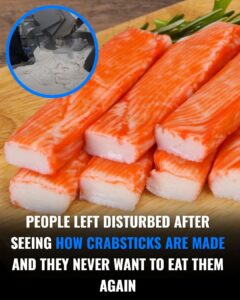
If you’ve ever enjoyed crabsticks in sushi or seafood salad, brace yourself. After seeing how they’re made, many viewers are saying: never again.
Behind the Seafood Section
Most of us eat without thinking much about how food is made. And maybe that’s for the best. After all, there’s a reason for the saying: “Everyone loves sausage, but nobody wants to see how it’s made.”
The same applies to crabsticks. A viral video spread from YouTube to nearly every social feed, taking viewers inside a crabstick factory. What began as curiosity quickly turned to shock.
What Are Crabsticks Made Of?
Here’s the first surprise: there’s no real crab in most crabsticks.
They start with frozen fish, usually Alaskan pollock — a cheap, abundant white fish. The fish is defrosted and mixed in industrial machines until it becomes a pale, mushy paste called surimi. This paste forms the base of imitation crab.
Surimi has a long history in Japanese cuisine, where it is traditionally prepared for various dishes. But modern industrial production looks very different.
Processors add binding agents like egg whites and wheat starch to the grey mass. The mixture becomes a thick, clay-like foam, far from anything found naturally in the ocean.
The Transformation Process
Next, workers flatten the paste into thin sheets. Machines roll it into layers to mimic the stringy texture of crab meat. An orange coating is applied to the outside to imitate a real crab shell, creating the familiar red-and-white look.
By the time it reaches stores, the product looks like crab — but it’s really just reconstituted fish with coloring.
The Internet Reacts
Once the video went viral, reactions poured in:
- “I will never purchase this ever again! Thank you for opening my eyes.”
- “I always thought this stuff was disgusting — now I know it is.”
The outrage wasn’t just about ingredients. Many were disturbed by the grey foam, the mechanical pressing, and the paint-like orange coating. For some, it felt like discovering a beloved childhood toy was a lie.

Food Deception or Reality?
Not everyone was shocked. Some pointed out that crabsticks are no worse than hot dogs or processed deli meats. If you already eat mass-produced food, does it matter whether crab is real?
“I know how it’s made, but I still love crabsticks in my sushi,” one viewer wrote. “It’s not real crab, but it tastes good — and that’s enough for me.”
This raises the question: do we value authenticity, or are we willing to enjoy clever illusions?
Why Imitation Crab Exists
The answer is cost. Real crab is expensive, labor-intensive, and limited in supply. Surimi-based crabsticks offer a similar flavor at a fraction of the price.
Flavor enhancers like MSG, sugar, salt, and fish extracts bring the paste close to real crab. Without them, imitation crab would taste like bland, rubbery fish paste. With them, it tricks both the taste buds and the wallet.
Safe but Unappetizing
Here’s the twist: crabsticks are generally safe. Factories meet food safety regulations, and ingredients are approved for consumption.
The issue isn’t hygiene — it’s perception. Once people see the grey paste, the artificial shaping, and the industrial machinery, the appeal disappears. The illusion breaks.
Will People Still Eat Them?
Crabsticks remain popular in sushi, salads, sandwiches, and pasta. Yet for many, the viral video changed everything.
Some say they’ll never see sushi the same way again. Others continue eating, just with less illusion — and perhaps more respect for the strange magic of modern food production.
Should You Be Worried?
If you enjoy crabsticks and aren’t concerned about production, there’s no need to panic. They are safe, convenient, and still tasty for many.
But if you value transparency and whole foods, this may be a wake-up call to rethink what goes on your plate.
Sometimes, knowing the truth changes everything. Other times, we choose to enjoy the illusion — one bite at a time.